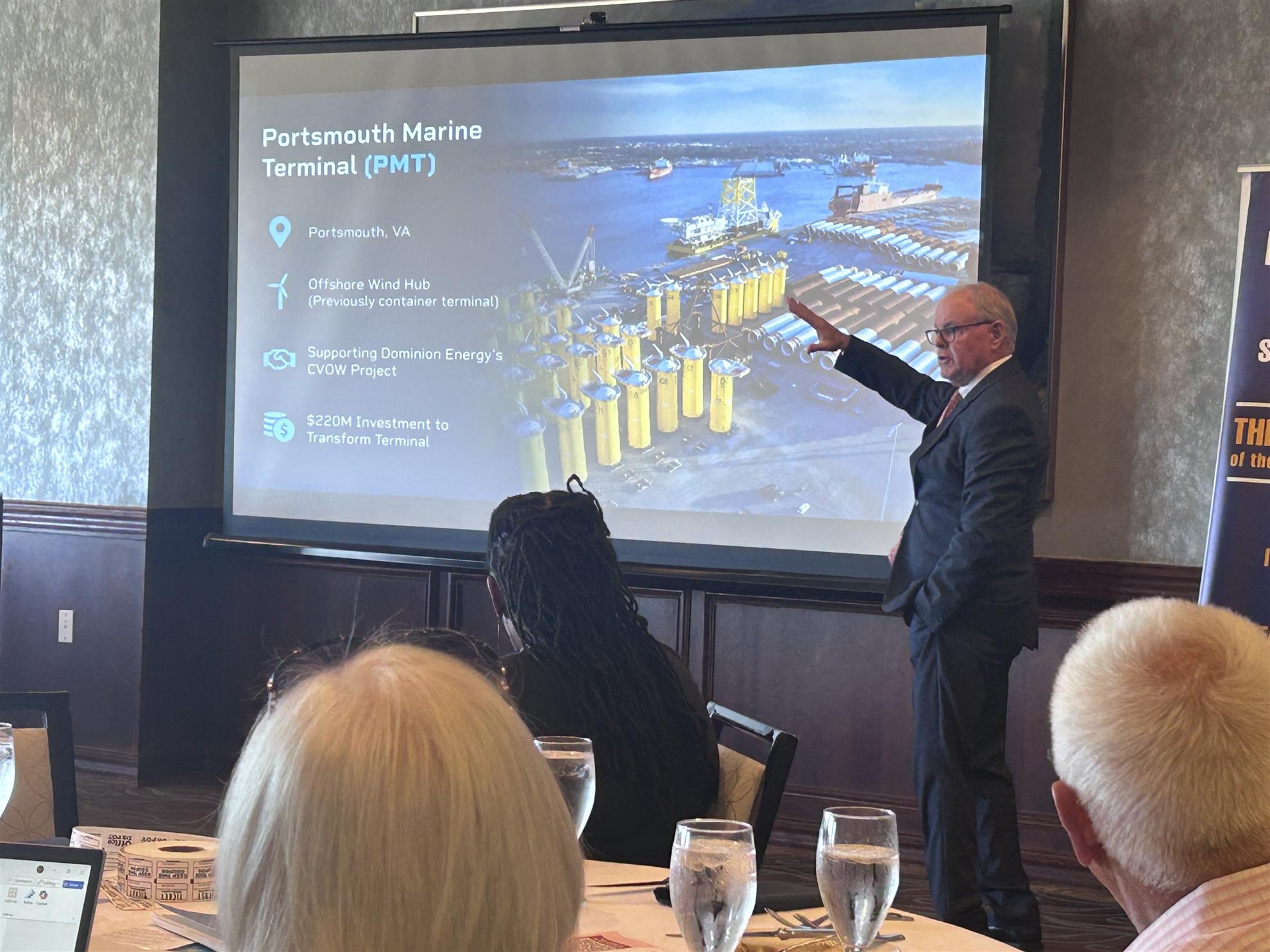
Joe Ruddy, chief operations officer at the Port of Virginia, presented an update on strategic initiatives underway across the port’s terminals.
Recognized as one of the nation’s most modern ports, the Port of Virginia operates five marine terminals managed by the Virginia Port Authority. Since the 2007 opening of the Virginia International Gateway, the port has emphasized technology and safety, including semi-automated container handling at Norfolk International Terminals.
The Virginia Port Authority’s model is unique among U.S. ports. It controls its chassis pool, owns assets and equipment, and serves as both a technology integrator and terminal operator. This structure prioritizes the Commonwealth’s interests over private business, contributing nearly $6 billion in annual tax revenue.
The Port of Virginia holds a 50-year lease-to-own agreement for the Virginia International Gateway, which offers on-dock rail service from CSX and Norfolk Southern. Norfolk International Terminals recently completed a $650 million modernization of its north berth to improve efficiency and rail access. Portsmouth Marine Terminal supports the state’s offshore wind projects, storing monopiles and other components. The port’s inland network includes the Virginia Inland Port in Front Royal and barge service to Richmond.
While experiencing some decline in activity, the Port of Virginia has fared better than many others. China remains its top trade partner, though trade with China and Hong Kong accounts for less than 20% of total volume. The European Union represents 26%, with strong rail connections supporting commerce.
Furniture is the port’s leading import, while soybeans and soybean products lead exports. The Port of Virginia operates entirely on clean energy from wind, solar, hydro and nuclear sources.