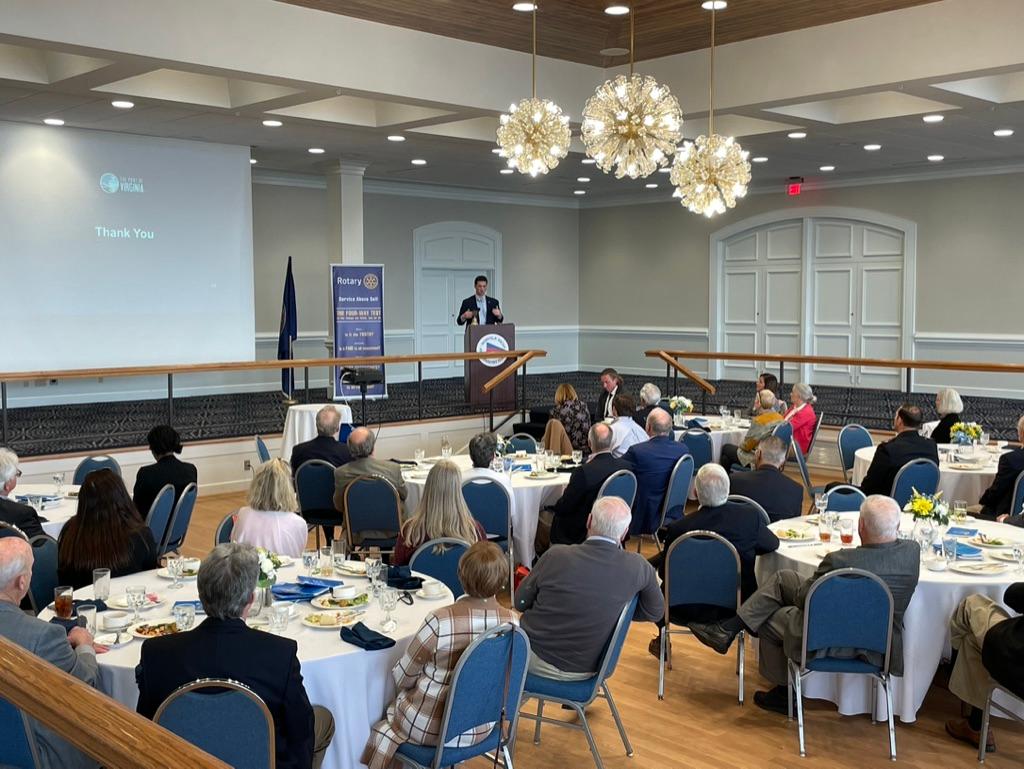
The speaker was Andrew Sinclair, the Director of Federal Government Affairs for the Port of Virginia.
Television networks have talked about the congestion at the ports over the past two years. It started when various countries shut down to try to bend the curve of the Coronavirus. Overseas manufacturers shut down which delayed ships. The shipping companies responded by taking some container vessels off their rotations. When demand outstripped supply, consumers responded by stocking up on essentials.
At the ports, a trucker shortage, which had been building for years, was unable to move the goods to their destinations. Additionally, as ships were not arriving and departing when anticipated, the ports were having to move goods around internally to make room for arrivals.
There was also a shift in consumer behavior with more consumers buying directly online from the manufacturer. There has been a shift from a consumer-based economy to a product-based economy.
In this environment, the Port of Virginia has good news to tell. It is the third-largest on the east coast and the fifth largest in the nation. While other ports were suffering from endless delays, the Port of Virginia had its best year ever in 2021 with a growth in BTUs (20-foot containers) of 25%. Additionally, the port can turn trucks around in less than 50 minutes while the standard is an hour which benefits the truckers who are paid by the load hauled.
The performance of the Port is because of an investment of $800 Million over the past five years, part of a $1.5 Billion planned infrastructure project. They have added container capacity through an automated stacking capability and have added two-ship form frames, 40 hybrid shuttle trucks, and 6,100 new chassis.
The Port also benefits from the “Virginia Model.” The multiple ports have a single owner/operator which allows them to move ships to where there is capacity unlike other ports such as Los Angeles and Long Beach which has two different port authorities and ten different operating companies competing for business.
To prepare for larger ships, the channel is being deepened from 50 feet to 55 feet at the dockside and deeper further out. They are also widening the channel which will enable ships to pass. Currently, it takes four hours for a ship to go from NIT to the ocean. This is a joint federal and state project.
The Meeting
Bill Davis’ wife died unexpectedly. She was also the mother-in-law of Rotarian John Searing.
We had three visitors including Thomas Croft. Ed Kellam and Walker Shivar, a retired orthodontist, brought by Chick Robison.
Club Business
Remember to pay your dues—25% of the club has not yet done so.
The Polio Plus baseball game is on May 15. Tickets are $15 and President Michael will secure a group of tickets.
Our Suds & Buds party is coming up soon on Thursday, May 19 at Norfolk Botanical Garden. It benefits PrimePlus, this year’s third partner, Norfolk Botanical Garden, and Norfolk Rotary Charities. It is the club’s major fundraiser. Remember to bring a bottle of wine valued at $20 or more for the wine pull, sign up for a committee on the night of the event, and to buy your tickets in advance.
Happy Bucks:
- Clay Dills firm was recognized for its work done on the pavilion for the Elizabeth River Foundation.
- George Nottingham has been named as one of the top financial advisors.
- Marilyn Gowen’s husband has a new car.
- Marcia Conston has a new grandchild.
- Rachel Bellis recently celebrated her ninth anniversary with PETA and has been promoted to the Associate Director of Local Affairs.
- Lorna Cochrane’s trip to Arizona
- Chick Robison was the officiant at his nephew’s wedding.
- Barbara Lifland for a trip to Colorado
- LauraBeth DeHority has a new car
- Lisa Chandler is happy that the first shift for the Suds & Buds party is almost filled with volunteers.
- Randy Garrett for a trip to the United Kingdom.